

Unusual glass-like masses scattered throughout the Australian desert provide proof of an old meteorite collision that researchers had overlooked until recently.
A recent study headed by geoscientist Anna Musolino from Aix-Marseille University in France suggests that small glass spheres discovered in South Australia form an impact-melt type that is unique to this location.
These newly named ananguites, the researchers state, came into existence due to a massive collision that occurred approximately 11 million years ago.
The drawback in this specific case is that geologists have not yet discovered any evidence of a crater linked to this occurrence – a phenomenon strong enough to create mineral remnants that remain detectable for millions of years.
Related: A Major Geological Unexpected Find Has Been Unearthed Beneath Greenland’s Ice Cover
 frameborder=”0″ allow=”accelerometer; autoplay; clipboard-write; encrypted-media; gyroscope; picture-in-picture; web-share” referrerpolicy=”strict-origin-when-cross-origin” allowfullscreen>
These spectacles are exclusive to Australia and have documented an ancient collision that we were previously unaware of,says geochronologist and geochemist Fred Jourdanfrom Curtin University in Australia.
“They formed when an asteroidcrashed into Earth, melting surface rock and spreading fragments over thousands of kilometers. These small glass particles serve as tiny time capsules from far beneath our planet’s past.
What adds to the mystery is that, despite the significant effect, researchers have not yet found the crater.
The arid region spanning southern Australia is densely covered with small fragments of impact glass known astektites. It is a part of an area referred to as theAustralasian strewnfield, the consequences resulting from a massive meteorite collision believed to have occurred in Southeast Asia approximately 788,000 years ago.
The tektites discovered from this event in Australia are referred to asaustralitesand they are especially numerous due to the fact that the suspected collision occurred not too long ago.
Back in 1969, researchers Dean Chapman and Leroy Scheiber from NASA conducted a chemical examination of 530 australites. Within that group,they found eightwith a mineral makeup that was different from the other parts of the sample.
They observed the oddity of this situation, proposing that the eight beads might have originated from a different collision, but no one ever truly pursued it further.
 Musolino and her team chose to revisit the unusual samples to uncover their mysteries. The initial eight samples could not be re-examined, but fortunately, Chapman and Scheiber had offered a thorough chemical analysis of the oddballs.
Notable differences include a reduced amount of silicon dioxide, yet increased levels of iron, magnesium, and calcium oxides. They are also more dense, exhibit greater magnetic susceptibility, have distinct bubble formations, and show different proportions of trace elements.
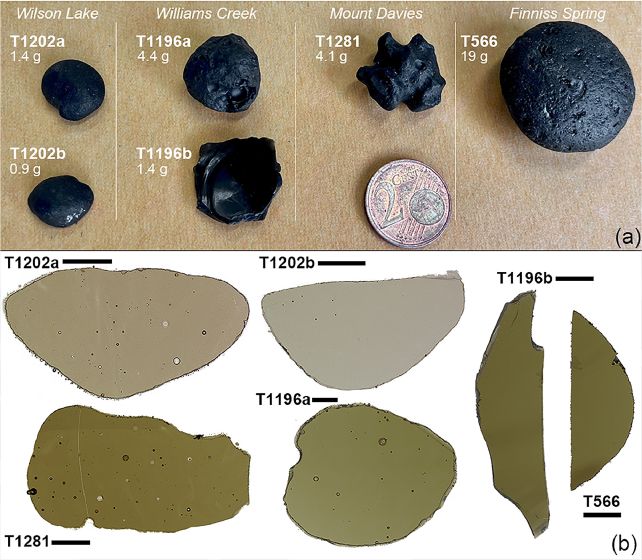
Armed with this profile, the researchers searched extensively forAustralian collection at the South Australian Museum, testing it for outliers that align with the unusual specimens identified by Chapman and Scheiber. They discovered six new tektites in the collection that matched the mineral signature of the earlier anomalies.
The makeup of these ananguites strongly suggests that they were created during an impact event that took place on a different section of the crust compared to the Australasian strewnfield impact.
To verify, Musolino and her team conductedargon datingin two of the six samples; Jourdan and other scientists applied the same method in 2019 to determine the age of tektites found across Southeast Asia and Australiato 788,000 years old.
The team concluded that the newly discovered ananguites are 11 million years old—much older than the tektites. This age confirms it; these small glass fragments originated from a separate, earlier impact.
Where that effect occurred, however, remains a major enigma. This is not unexpected considering the origin crater of the Australasian strewnfield tektites is still unidentified, regarded as something of a “holy grailregarding the study of impact craters.
There are also several possible explanations for why the Ananguite source crater may have disappeared, such as significant weathering and the aridification of central Australia that beganapproximately 33 million years ago. It could have also been confused with a volcanic feature in areas like Papua New Guinea.
Distinct geochemical and petrographic characteristics between western and eastern ananguites, which require further verification through more samples, could aid in determining the impact site,the scientists state in their study.
Nevertheless, it’s also conceivable that the crater has been covered over in the last 11 million years.
The results have been made public inEarth and Planetary Science Letters.






Leave a Comment