
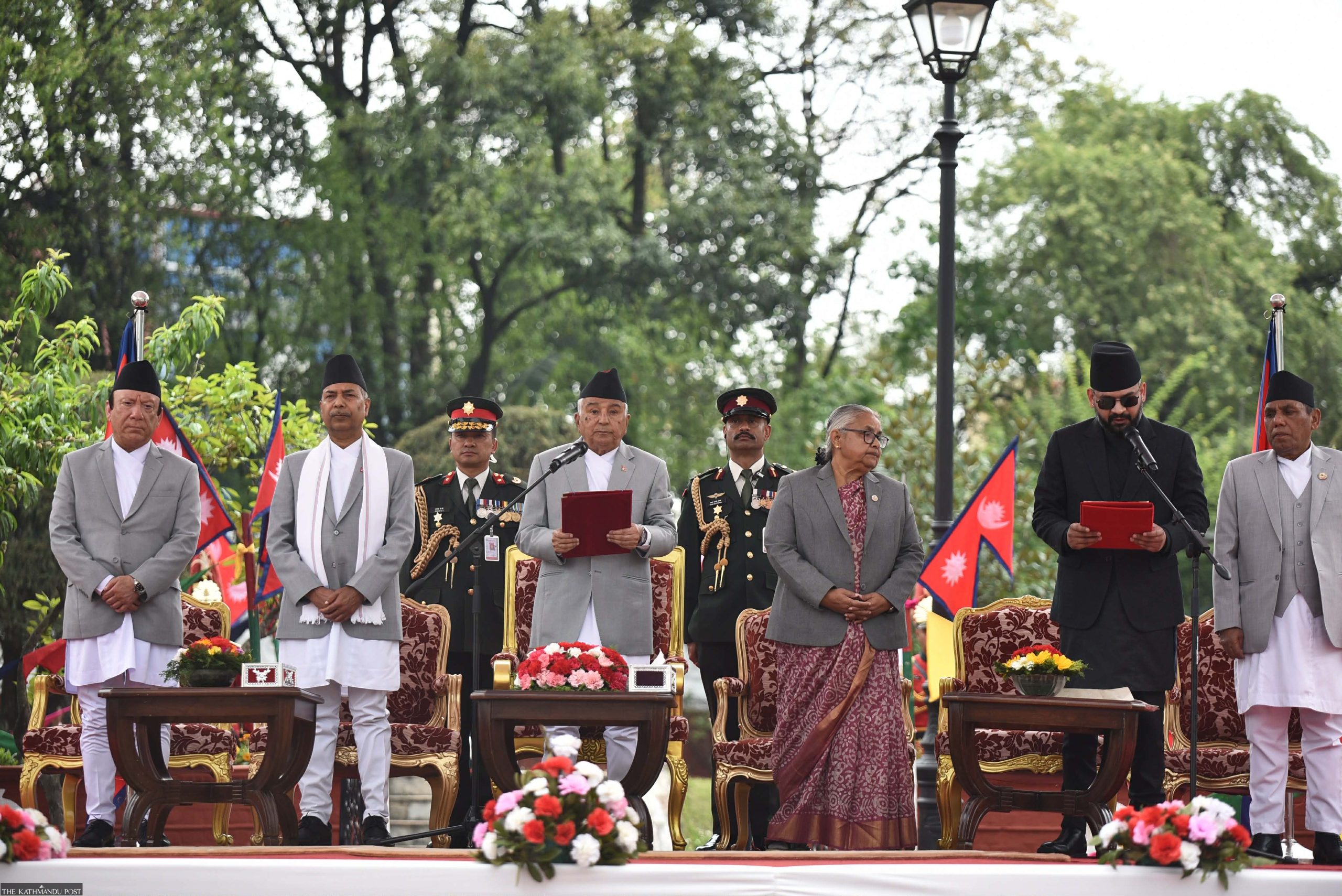
Kathmandu, March 28 — Three weeks following his triumph over former Prime Minister and CPN-UML leader KP Sharma Oli in the elections held on March 5, senior member of the Rastriya Swatantra Party, Balendra Shah, assumed the role of the nation’s executive leader on Friday.
President Ramchandra Paudel administered the oath of office and secrecy to the 35-year-old prime minister during a special event at Sheetal Niwas.
The inauguration ceremony featured the blowing of conch shells, known as shankhanaad. Furthermore, 108 Batuks recited the swastishanti, and Buddhist monks carried out the ashtamangal chanting.
This is the first instance where a leader from the Madheshi community has assumed the role of prime minister.
A hip-hop artist and civil engineer, Shah gained recognition after he achieved a surprising victory in the 2022 local elections as an independent candidate, defeating contenders from established political parties by large margins to become the mayor of Kathmandu, the nation’s largest city.
Shah was the mayor of Kathmandu Metropolitan City from May 2022 until he stepped down in January 2026, and later officially became a member of the RSP at the close of 2025.
After Shah’s swearing-in, President Paudel also took the oath of 14 additional ministers. RSP vice-chair Swarnim Wagle has been appointed as the Finance Minister. He is a specialist in economic matters and was elected twice from Tanahun-1 to the House of Representatives, including the March 5 parliamentary elections.
Sudan Gurung, who gained recognition during the Gen Z movement, has been appointed as the minister of home.
Shishir Khanal has been assigned to the foreign ministry. He leads the RSP’s department responsible for international relations.
In the same way, Khadak Raj (Ganesh) Paudel has been named as the minister responsible for Culture, Tourism, and Civil Aviation. As a writer, he was elected from Kaski-1. Dipak Sah from Mahottari has assumed the role of minister for Labour and Employment.
Sasmit Pokharel, who was elected from Kathmandu-5, has been named as the minister responsible for Education, Science and Technology, and Youth and Sports. Similarly, Bikram Timilsina has taken up the position in the Ministry of Communication and Information Technology, whereas Pratibha Rawal is the minister overseeing Federal Affairs and General Administration, along with Land Management, Cooperatives, and Poverty Alleviation. She comes from a journalism background and was elected through the proportional representation system. Rawal also holds the role of co-spokesperson for the party.
Biraj Bhakta Shrestha serves as the minister responsible for Energy, Water Resources, and Irrigation in the Shah Cabinet.
Gita Chaudhary holds the position of Minister for Agriculture, Livestock Development, Forests, and the Environment. She was elected through a proportional representation system and became a member of the RSP just prior to the elections. Additionally, she works as an attorney.
Sobita Gautam has taken on the role of Minister for Law, Justice, and Parliamentary Affairs. As a legal professional, she beat former Bharatpur mayor Renu Dahal in Chitwan-3 during the parliamentary elections held on March 5.
Sita Badi is now leading the Ministry for Women, Children, and Senior Citizens, whereas Sunil Lamsal serves as the Minister for Physical Infrastructure, Transport, and Urban Development. Nisha Mehata has been appointed as the Minister responsible for Health and Population, along with Water Supply.
In alignment with the essence of the Gen Z movement, the main responsibilities of the new administration are well-defined: promote effective governance, curb corruption, enhance the quality of public services, boost economic development, and generate employment opportunities.
However, as former prime minister and finance minister Baburam Bhattarai warns, none of these goals can be accomplished in a single day. “Good governance and effective service provision are not things that one individual can accomplish through magic,” he stated.
In a democratic system, lasting change needs to be built into the institutions, involving step-by-step enhancements across national and regional governments, constitutional organizations, the court system, and law enforcement agencies, he stated. With a strong majority, the government has both the chance and duty to advance enduring reforms via legislation, policies, and the reinforcement of institutions.
Political scientist Karma Tamang shares this perspective but highlights the need for immediacy. She contends that existing laws are insufficient for achieving effective governance. “Legislative delays that previously took months must now be addressed within weeks. Utilizing information technology to simplify public services can greatly enhance efficiency and availability,” she stated.
This sense of urgency stems from Nepal’s recent political past. Following the adoption of the constitution in 2015, there have been frequent changes in government, yet structural reforms have not kept pace. Different administrations have advocated for federalism when they were in opposition, but once in power, they tended to concentrate authority again.
Consequently, even after ten years, provincial governments continue to be weak, frequently operating as administrative branches of the central authority. Key legislation—especially those related to policing and civil service—has yet to be passed, causing provinces to rely on Kathmandu for even basic administrative choices.
The challenge of federalism
Balendra Shah’s comments in Madhesh Province in January highlighted this dissatisfaction. He stated that provinces should not need to travel to Kathmandu to claim their rights. This represented a change in stance for the Rastriya Swatantra Party (RSP), which had previously shown uncertainty about federalism. In the 2022 elections, the party’s stance caused concerns, with some officials even proposing the removal of federalism.
During the Janakpur campaign rally, Shah’s remarks aimed to address these worries. By highlighting the importance of strengthening the provinces, he indicated a rhetorical dedication to ensuring federalism functions effectively. “Provinces should be made so powerful that there is no need to go to Kathmandu,” he stated, noting that the capital should only be visited for religious purposes, not for administrative reasons.
Experts claim that this vision goes beyond mere words. Khim Lal Devkota, an expert on federalism, highlights that the constitutional structure already supports decentralization; the challenge is in putting it into practice. Without essential laws—such as the Civil Service Act, Police Act, and Education Act—the provinces are unable to carry out their responsibilities. More importantly, the approach to governance is still centralized. “Transforming this will be just as tough as enacting legislation,” Devkota states.
The government of RSP therefore encounters a structural issue: converting constitutional promise into administrative practice. Earlier administrations were unsuccessful in establishing the legal and organizational framework required for federalism to operate effectively. Shah now takes on both the chance and the responsibility of addressing this problem.
Political coordination and constraints
Although the RSP is strong in the federal parliament, its influence within the wider state framework is restricted. It does not head any provincial government and has very little presence at the municipal level. In a federal system, the execution of policies depends largely on provincial and local governments—the levels nearest to the public.
This leads to an urgent requirement for political collaboration. In six out of the seven provinces, authority is held by coalitions headed by established parties like the Nepali Congress and the CPN-UML. Local governments are also controlled by these parties. Without their support, even effectively crafted policies from the central government might face difficulties in implementation.
Institutional limitations go deeper. The RSP does not have a presence in the National Assembly, which complicates the process of making constitutional changes. Significant reforms—especially those involving federal restructuring—necessitate wide-ranging political agreement, including support from the provinces. As Baburam Bhattarai highlights, even a government with a majority cannot ignore this situation.
Legal professionals also warn about excessive power. Advocate Semanta Dahal recommends that constitutional changes should first concentrate on enhancing governance systems—such as reinforcing supervisory entities like the CIAA, the Office of the Auditor General, and the National Human Rights Commission. “This is the right approach instead of trying to make broad structural modifications that require significant political discussion,” Dahal mentioned.
In the meantime, the influence of past governments still affects the state’s structure. Individuals appointed to constitutional organizations, long-standing bureaucratic methods, and a centralized administrative culture all create obstacles for quick changes. The danger lies in a discrepancy between public hopes—inspired by the Gen Z movement—and the speed at which institutions can genuinely evolve.
Stability and internal dynamics
A different test involves political stability. Nepal’s recent past provides minimal confidence: no administration since 1991 has finished a complete five-year period. Internal party conflicts frequently turn out to be as disruptive as outside resistance.
Concerns have already arisen regarding the distribution of authority between the party leadership and the government leadership for the RSP. The dynamic between party chairman Rabi Lamichhane and Prime Minister Shah will be closely observed. The existence of dual centers of power may weaken governance and diminish public trust.
The pressure is intense. The RSP gained power by pledging to accomplish what conventional parties could not. A failure to maintain internal unity and meet external demands may swiftly transform public hope into disappointment.
The path forward
Merely having parliamentary support will not ensure victory. The Shah administration needs to manage a challenging environment influenced by bureaucratic sluggishness, constitutional limitations, political division, and financial challenges. Fulfilling commitments regarding effective governance will demand more than just willingness, but also ongoing structural changes.
Economic challenges introduce an additional level of complexity. The pace of growth is slow, government funds are restricted, and income generation is facing pressure. Meanwhile, demands for progress are significant. Closing this gap will necessitate creative policies along with strict execution.
Legal changes will play a key role. Simplifying administrative procedures, defining clear responsibility systems, and eliminating gaps that let political figures avoid accountability are crucial actions. The ongoing habit of protecting political choices by calling them “policy decisions” needs to be tackled for anti-corruption initiatives to be trustworthy.
Similarly, the issue of international relations and preserving equilibrium also significantly impacts the government’s stability.
Former Prime Minister Baburam Bhattarai suggests that Nepal should focus on preserving a fair relationship with its two significant neighboring countries. “We are located between two major nations, India and China. However, in recent years, Western powers—especially the United States—have grown more involved and confident in multiple areas. In this scenario, there is a possibility that a three-way competition among major global centers might become more pronounced in Nepal,” he stated.
Ultimately, the government needs to handle the aftermath of the Gen Z movement. Widespread public frustration with corruption and lack of accountability was a key factor in the political changes. The findings from the Gauri Bahadur Karki commission, established to look into the suppression of the movement, is still a controversial topic. Putting its suggestions into action while keeping general public confidence will be a challenging task.



Leave a Comment